
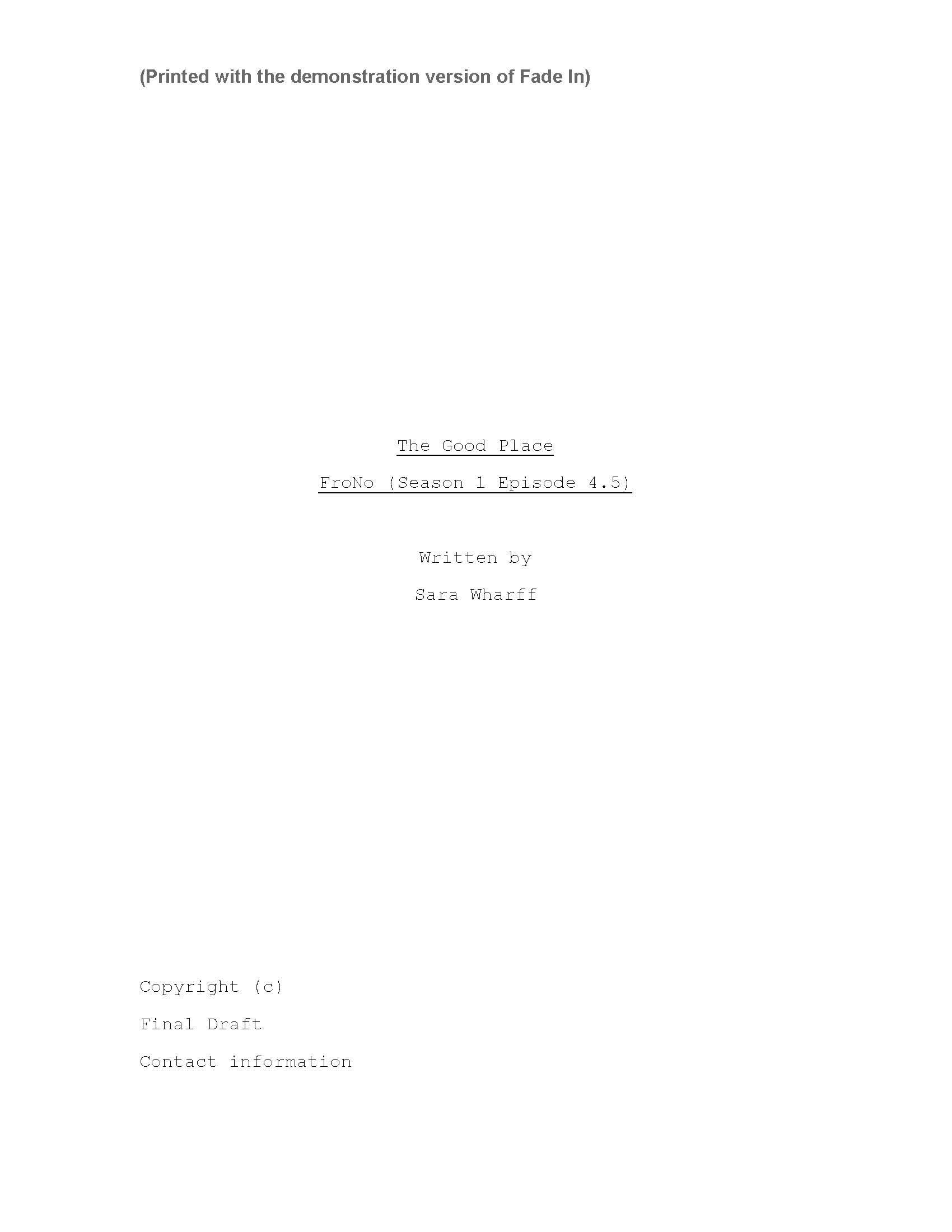
The Good Place "FroNo" Season 1 Episode 4.5
"FroNo," Season 1, Episode 4.5 of The Good Place, expands on the sinkhole dilemma presented in Episode 4 while illustrating the show's message of how it is impossible to live a truly ethical life amid the moral ambiguity and unintended consequences of navigating the modern world.
Throughout the episode, Chidi's attempts to resolve the sinkhole force him to grapple with the moral implications of his actions, highlighting his character's ongoing obsession with living a righteous life. Meanwhile, Eleanor faces challenges running a frozen yogurt shop while concealing her true identity. Ultimately, Her efforts and desire for harmony stop the sinkhole from expanding, demonstrating her gradual character growth. Whereas her past self on Earth would be indifferent to conflict, Eleanor now actively seeks harmony in the neighborhood.
Before writing, I rewatched The Good Place to refresh my memory of the story and understanding of character intricacies. This allowed me to incorporate dialogue reflecting their nuances, such as Michael's excitement to try new things as a human and his frequent use of pop-culture references. Rewatching also helped me understand the show's structural patterns. For instance, Season 1 prominently features flashbacks, so I included one to maintain the style. These flashbacks often do not tie directly into the present-day dialogue but instead showcase the character's past behavior on Earth.
While Tahani’s role in the episode is brief—since she is presumably preparing for the brunch she mentions planning in episode 4, which is held in episode 5 and is irrelevant to this episode—her dialogue emphasizes her love of aesthetics, highlights her rivalry with her sister (an ongoing series motif), and reflects her assumption that Eleanor belongs in The Good Place. By limiting Tahani's presence, I stayed true to Season 1’s style, in which episodes often do not heavily feature all main characters.
Due to the show's fast-paced nature, scenes often end on a cliffhanger or a comedic note, compelling the audience to keep watching. I followed this format to maintain the same writing style. For example, at the end of Act 3, when Michael asks, "How many people would you say you've served today?" the answer is irrelevant. The question adds suspense to the scene's conclusion, leaving the audience wondering how Eleanor will respond: truthfully or not?
Furthermore, I also maintained structural consistency by keeping action concise and integrating exposition throughout the episode. This approach ensures that anyone can follow the script without having to watch previous episodes. Such formatting is crucial in sitcoms that incorporate fantastic elements, as the storyline can quickly become confusing for occasional or new viewers.
Applications
- Fade In
"FroNo," Season 1, Episode 4.5 of The Good Place, expands on the sinkhole dilemma presented in Episode 4 while illustrating the show's message of how it is impossible to live a truly ethical life amid the moral ambiguity and unintended consequences of navigating the modern world.
Throughout the episode, Chidi's attempts to resolve the sinkhole force him to grapple with the moral implications of his actions, highlighting his character's ongoing obsession with living a righteous life. Meanwhile, Eleanor faces challenges running a frozen yogurt shop while concealing her true identity. Ultimately, Her efforts and desire for harmony stop the sinkhole from expanding, demonstrating her gradual character growth. Whereas her past self on Earth would be indifferent to conflict, Eleanor now actively seeks harmony in the neighborhood.
Before writing, I rewatched The Good Place to refresh my memory of the story and understanding of character intricacies. This allowed me to incorporate dialogue reflecting their nuances, such as Michael's excitement to try new things as a human and his frequent use of pop-culture references. Rewatching also helped me understand the show's structural patterns. For instance, Season 1 prominently features flashbacks, so I included one to maintain the style. These flashbacks often do not tie directly into the present-day dialogue but instead showcase the character's past behavior on Earth.
While Tahani’s role in the episode is brief—since she is presumably preparing for the brunch she mentions planning in episode 4, which is held in episode 5 and is irrelevant to this episode—her dialogue emphasizes her love of aesthetics, highlights her rivalry with her sister (an ongoing series motif), and reflects her assumption that Eleanor belongs in The Good Place. By limiting Tahani's presence, I stayed true to Season 1’s style, in which episodes often do not heavily feature all main characters.
Due to the show's fast-paced nature, scenes often end on a cliffhanger or a comedic note, compelling the audience to keep watching. I followed this format to maintain the same writing style. For example, at the end of Act 3, when Michael asks, "How many people would you say you've served today?" the answer is irrelevant. The question adds suspense to the scene's conclusion, leaving the audience wondering how Eleanor will respond: truthfully or not?
Furthermore, I also maintained structural consistency by keeping action concise and integrating exposition throughout the episode. This approach ensures that anyone can follow the script without having to watch previous episodes. Such formatting is crucial in sitcoms that incorporate fantastic elements, as the storyline can quickly become confusing for occasional or new viewers.
Applications
- Fade In

Ember TV Commercial
"Temperature Matters", employs the rhetorical persuasion method of Pathos to appeal to the audience's desire for a drink that is always warm. The commercial presents the problem of how regular mugs fail to keep drinks warm and positions the Ember mug as the solution. Since Ember's marketing typically centers on people enjoying a mug of coffee, I aimed to maintain the positive tone of their previous advertisements while taking a more unique approach.
The commercial takes place in an igloo to immediately grab the audience's attention, given its unusual setting. Opening with an unexpected exterior shot of the igloo piques the audience's interest and encourages them to continue watching. The scene then cuts to two men drinking from mugs within the igloo. By featuring adult subjects, the commercial directly targets Ember's core demographic. The audience quickly grasps the problem and solution through Bob and Frank's contrasting demeanors. While Bob fails to get warm from a generic mug, Frank is happily content with his Ember mug. The commercial juxtaposes Bob's frantic, anxious nature with Frank's calm savoring of his drink, suggesting that the Ember mug is a positive, calming experience. Additionally, the commercial exaggerates Bob's response to the cold through a comedic lens to highlight this seemingly trivial issue, but ultimately presents it as relatable.
At the end, Frank offers Bob an Ember mug, thus solving the problem. This positions Frank and, subsequently, people who use the Ember mug as generous, kind individuals. The strategic use of minimal dialogue, especially from Frank, enables his only line, "Temperature matters," to pack a punch. His statement ties directly into Ember's slogan, which appears at the end of the commercial, "The Perfect Temperature Every Time." The audience is left knowing that, even in extreme circumstances such as being encapsulated in ice, an Ember mug can save the day because it always stays warm.
Applications
- Photoshop
- Google Docs
"Temperature Matters", employs the rhetorical persuasion method of Pathos to appeal to the audience's desire for a drink that is always warm. The commercial presents the problem of how regular mugs fail to keep drinks warm and positions the Ember mug as the solution. Since Ember's marketing typically centers on people enjoying a mug of coffee, I aimed to maintain the positive tone of their previous advertisements while taking a more unique approach.
The commercial takes place in an igloo to immediately grab the audience's attention, given its unusual setting. Opening with an unexpected exterior shot of the igloo piques the audience's interest and encourages them to continue watching. The scene then cuts to two men drinking from mugs within the igloo. By featuring adult subjects, the commercial directly targets Ember's core demographic. The audience quickly grasps the problem and solution through Bob and Frank's contrasting demeanors. While Bob fails to get warm from a generic mug, Frank is happily content with his Ember mug. The commercial juxtaposes Bob's frantic, anxious nature with Frank's calm savoring of his drink, suggesting that the Ember mug is a positive, calming experience. Additionally, the commercial exaggerates Bob's response to the cold through a comedic lens to highlight this seemingly trivial issue, but ultimately presents it as relatable.
At the end, Frank offers Bob an Ember mug, thus solving the problem. This positions Frank and, subsequently, people who use the Ember mug as generous, kind individuals. The strategic use of minimal dialogue, especially from Frank, enables his only line, "Temperature matters," to pack a punch. His statement ties directly into Ember's slogan, which appears at the end of the commercial, "The Perfect Temperature Every Time." The audience is left knowing that, even in extreme circumstances such as being encapsulated in ice, an Ember mug can save the day because it always stays warm.
Applications
- Photoshop
- Google Docs